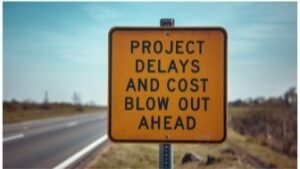
We need to talk about a problem that’s costing New Zealand millions and putting our infrastructure plans at risk. Even though we’re in the top 10% of OECD countries for funding, we’re in the bottom 10% for turning that spend into the benefits people were promised. You’ll have seen the headlines: big budget blowouts, long delays, and projects that spiral before they’ve barely started. And while it feels close to home, it isn’t unique to Aotearoa. Cost overruns and schedule slips show up worldwide—and they’ve been showing up for decades.
The root of the problem: optimism meets reality
Research led by Professor Bent Flyvbjerg points to an uncomfortable reality: many projects are set up to fail before the design is even locked in. The main drivers are (1) optimism bias—people genuinely believing it will be cheaper and faster than it will be—and (2) procurement settings that reward the lowest price rather than the most realistic plan.
This is how the cycle usually plays out:
The Setup for Failure:
- Project teams underestimate complexity, time, and cost.
- Competitive tendering pushes contractors to bid lean to win the work.
- We often plan as if productivity will be strong, despite long-running, system-wide productivity challenges.
- Contractors see the risks, but pricing them honestly can mean losing the bid.
- Risk gets “transferred” to contractors on paper, but in practice it bounces back through variations, claims, or delays.
- During delivery, commercial survival can turn into a focus on claims, recovery, and dispute rather than outcomes.
The Misaligned Objectives:
- Clients want services and community benefits delivered.
- Contractors need a fair margin to stay in business.
- Poorly set contracts can put those goals in conflict instead of lining them up.
The Risk Management Mirage
Even when New Zealand organisations do “risk management”, it can be more box-ticking than decision-making. A common pattern is applying a standard contingency (say a flat percentage) to the estimate and calling it “risk analysis”. That isn’t analysis—especially when it’s not grounded in relevant historic data from comparable projects (including ones that blew out).
Good risk analysis starts with your actual scope, context, capability, and constraints. It means naming the risks that might occur, testing how they affect the schedule (especially the critical path), and factoring in real-world limits like access windows, resource availability, consenting, and weather.
Too often, we treat risk as a cost problem only. But the real currency of a project is time. Delays drive costs (extra prelims, escalation, rework, claims). Cost increases don’t automatically cause delays—but delays almost always increase costs.
When Risk Analysis Goes Wrong
Here’s a common trap. You identify the main risks on the critical path and build a plan around them. Then a major issue hits somewhere else—outside the critical path. Suddenly that work becomes critical, your sequence changes, and the completion date shifts into a period when you can’t get access, utilities outages aren’t available, or key crews and equipment are tied up elsewhere. The result is delay-on-delay, and it often catches leaders off guard because the original risk plan didn’t test these knock-on scenarios.
Potential Solutions: A Different Approach
So what would help? Not a magic fix—but a few shifts that would materially improve delivery:
- Be explicit about benefits and trade-offs: Start with the outcomes you’re trying to achieve, then work backwards to the scope, delivery approach, and risks that could stop you getting there.
- Do schedule risk properly: Model realistic scenarios (not just “best/most likely/worst”) and test what happens when risks land off the critical path and then become critical.
- Align incentives through contracting: Use delivery models and contract terms that share risk fairly, reward collaboration, and reduce the payoff from disputes and claims.
- Change what procurement rewards: Select for capability, programme realism, and risk transparency—not just a low number at tender time.
What good looks like (an example)
Imagine a state highway safety upgrade programme (say a mix of widening, intersection upgrades, barriers, and resurfacing). Before funding is signed off, the team uses real NZ benchmark data from similar road works, builds a schedule model that stress-tests disruption scenarios (traffic management restrictions, possession windows, utilities relocations, pavement supply lead times, weather), and agrees a delivery model where the client and contractor share key risks and make early decisions together.
- Business case states the safety/outcome benefits, the minimum scope to achieve them (e.g., which intersections, which lengths, what standards), and what’s explicitly out of scope.
- Baseline programme shows the critical path and the real constraints: traffic management staging, lane closures, night works, holiday embargoes, and any “no-go” dates for key routes.
- Risk register is tied to time impacts (what shifts the finish date): pavement failures found once you open it up, unexpected ground conditions, utility conflicts, consenting, and weather events that shut down paving.
- Contingency is evidence-based (from data and modelled scenarios), and separated into cost and time—so you can see whether you’re short on money, short on possession windows, or both.
- Procurement evaluates realism and capability (programme logic, traffic management approach, pavement methodology, supply chain, key people), not only price.
- Contract sets shared outcomes and clear processes for change (especially around traffic staging, utilities, and unforeseen ground), so problems get solved early rather than fought over later.
Over to you
These changes make sense on paper, but they’re hard to land in the real world. Competitive tendering is built into public procurement, there’s pressure to announce projects with attractive price tags, and capability in schedule and risk analysis is still patchy across the system.
If you’ve worked on NZ road projects (for the client or for a contractor), I’d value your practical take:
- Project managers / planners: Where does the programme usually slip first—consenting, utilities, traffic management, supply chain, or something else?
- Contractors / bid teams: What would make it easier to price risk honestly and still be competitive?
- Clients / public sector: Which procurement settings are fixed today, and where is there room to change what we reward?
- Risk / commercial specialists: What’s one practice that materially improves time risk on roads projects (and one that looks good on paper but doesn’t work)?
And a few specific questions:
- How do we design procurement that rewards realistic time risk (without killing competition)?
- What would actually lift schedule and risk capability across clients and suppliers—training, centres of excellence, independent review, different contracts?
- Where should independent schedule/risk review sit in approvals—early business case, pre-tender, or both?
- The cost of continuing with business as usual is too high. Every failed project represents not just wasted money, but lost opportunities for the infrastructure and services our communities need.
If you’ve seen a road project, go well (or come unstuck), share what made the difference. One concrete example—what the contract/procurement rewarded, how time risk was handled, or what you’d do differently next time—would be hugely useful. If you’d rather send feedback privately, email me at [email protected].